Category: Uncategorized

  • BBC sees UAE-run secret prisons

    BBC sees UAE-run secret prisons


    Nawal Al-MaghafiSenior international investigations correspondent, Yemen

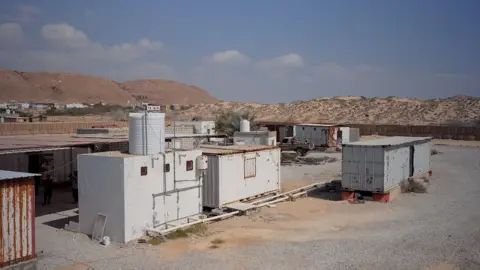
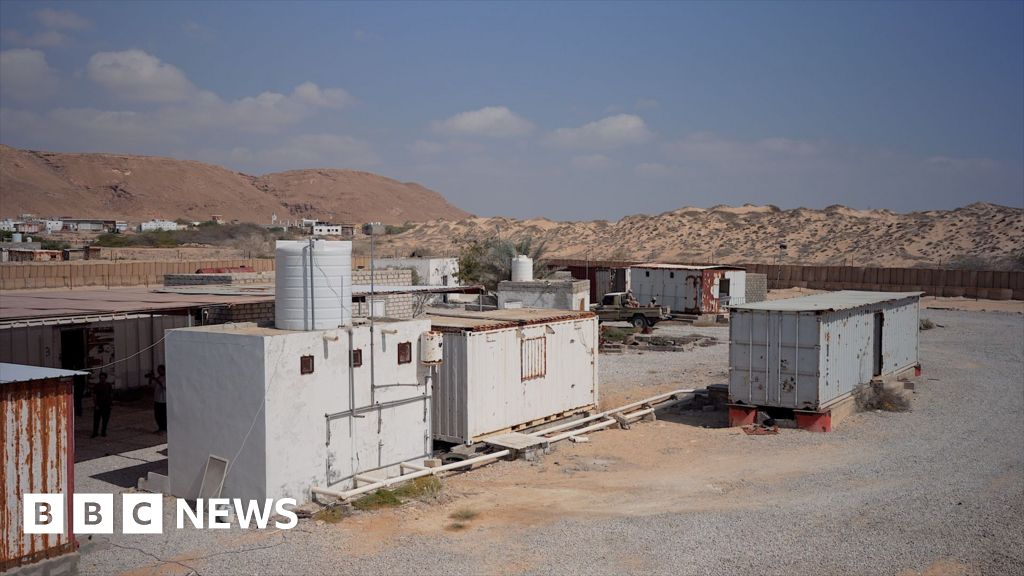
    Liam weir / BBC One white shipping container and two grey ones are seen on a gravel area with sandy hills behind them. A small white building with a water tank on it is next to one of them.Liam weir / BBC

    One of the sites had several shipping containers with little ventilation, where detainees said up to 60 men were held

    The BBC has been given access to detention facilities on former United Arab Emirates military bases in Yemen, confirming long-standing allegations of a network of secret prisons run by the UAE and forces allied to it in Yemen’s decade-long civil war.

    One former detainee told the BBC he had been beaten and sexually abused at one of the sites.

    We saw cells at two bases in the south of the country, including shipping containers with names – apparently of detainees – and dates scratched into the sides.

    The UAE did not respond to our request for comment, but has previously denied similar allegations.

    Until recently, the Yemeni government, which is backed by Saudi Arabia, was allied with the UAE against the Houthi rebel movement which controls north-west Yemen.

    But the alliance between Yemen’s two Gulf state partners has fractured. UAE forces pulled out of Yemen in early January and Yemeni government forces and groups allied to them have retaken large swathes of the south from separatists backed by the UAE.

    This includes the port of Mukalla, where we landed in a Saudi military plane and were taken to visit the former UAE military bases in the Al-Dhaba Oil Export Area.

    It has been almost impossible for international journalists to get visas to report from Yemen in recent years, but the government invited reporters to view the two sites, accompanied by Yemen’s Information Minister Moammar al-Eryani.

    What we saw was consistent with accounts we have gathered independently, both in our previous reporting and also interviews conducted in Yemen, separately from the government-run site visit.

    ‘No space to lie down’

    At one site, there were about 10 shipping containers, their interiors painted black, with little ventilation.

    Messages on the walls appeared to mark the dates detainees said they were brought in, or to count the number of days they had been held.

    Several were dated as recently as December 2025.

    At another military base, the BBC was shown eight cells built from brick and cement, including several measuring about one metre square and two metres tall, which Eryani said were used for solitary confinement.
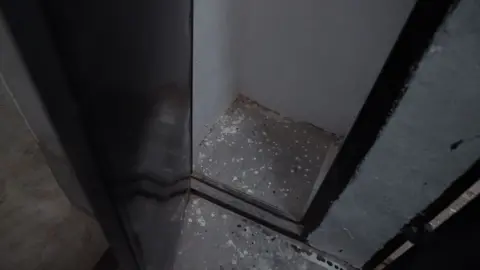
    Liam Weir / BBC Photo looking down showing the lower part of a cell that is about a metre by a metre in size, with a concrete floor and white-painted walls. Its tall black door is open.Liam Weir / BBC

    One site had several cells that were about a metre square, which the Yemeni government said were used for solitary confinement

    Human rights groups have documented testimony describing such facilities for years.

    Yemeni lawyer Huda al-Sarari has been gathering accounts.

    The BBC independently attended a meeting she organised, where about 70 people were present who said they had been held in Mukalla, as well as the families of another 30 who they said their relatives were still in detention.

    Several former detainees told us that each shipping container could hold up to 60 men at a time.

    They said prisoners were blindfolded, bound at the wrists and forced to remain sitting upright at all hours.

    “There was no space to lie down,” one former prisoner told the BBC. “If someone collapsed, the others had to hold him up.”

    ‘All types of torture’

    The man also told the BBC he was beaten for three days after his arrest, with interrogators demanding he confess to being a member of al-Qaeda – an accusation he denies.

    “They told me if I didn’t admit it, I would be sent to ‘Guantanamo’,” he said, referring to the US military detention centre at Guantanamo Bay in Cuba.

    “I didn’t even know what they meant by Guantanamo until they took me to their prison. Then I understood.”

    He said he was held there for a year and a half, beaten daily and abused.

    “They didn’t even feed us properly,” he said. “If you wanted the toilet, they took you once. Sometimes you were so desperate you did it on yourself.”

    He says his captors included Emirati soldiers as well as Yemeni fighters: “All types of torture – when we were interrogated it was the worst. They even sexually abused us and said they would bring in the ‘doctor’.

    “This so-called doctor was Emirati. He beat us and told the Yemeni soldiers to beat us too. I tried to kill myself multiple times to make it end.”
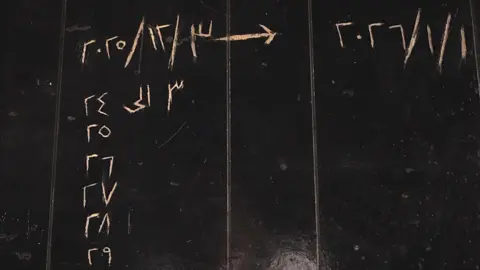
    Liam Weir / BBC Black-painted wall with dates in Arabic scratched into itLiam Weir / BBC

    Dates were scratched into the black sides of the shipping containers

    The UAE was leading a counter-terror campaign in southern Yemen, but human rights groups say thousands of people were detained in crackdowns on political activists and critics.

    A mother told us her son was detained as a teenager and has been held for nine years.

    “My son was an athlete,” she said. “He had just come back from competing abroad. That day he went to the gym and never came back.”

    “I didn’t hear from him for seven months,” she said.

    “Then they let me see him for 10 minutes. I could see all the scars of the torture.”

    She alleged that in the prison at the Emirati-run base, her teenage son was electrocuted, doused with ice-cold water and sexually abused multiple times.

    She says she attended a hearing in which her son’s accusers played a recording of him apparently confessing.

    “You can hear him being beaten in the background and told what to say,” she said. “My son is not a terrorist. You have robbed him of the best years of his life.”

    Testimony and allegations

    Over the past decade, human rights groups and media organisations – including the BBC and Associated Press – have documented allegations of arbitrary detention, enforced disappearance and torture in detention centres run by the UAE and its allies.

    Human Rights Watch said in 2017 it had gathered testimonies of detainees held without charge or judicial oversight in unofficial facilities, and subjected to beatings, electric shocks and other forms of ill treatment.

    The UAE denied these allegations when they were made.

    The BBC sent detailed allegations to the UAE government about the detention sites we visited and accounts of abuse, but received no response.

    All sides have been accused of human rights violations in the civil war, which has sparked a devastating humanitarian crisis in the country.

    Families’ questions
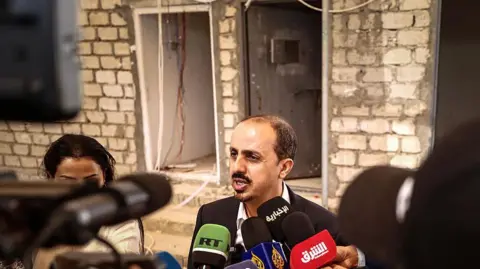
    Fadel SENNA / AFP via Getty Image Yemeni Information Minister Moammar al-Eryani speaking with a lot of journalists' microphones in front of him. He is bald with a beard and mustache, and is standing in front of a brick and cement building.Fadel SENNA / AFP via Getty Image

    Minister Moammar al-Eryani said victims had told the government the prisons existed, “but we didn’t believe it was true”

    Families of detainees told the BBC they had repeatedly raised concerns with Yemeni authorities.

    They believe it would have been impossible for the UAE and its allies to run a detention network without the Yemeni government and its Saudi backers knowing about it.

    The information minister, Eryani, said: “We weren’t able to access locations that were under UAE control until now.

    “When we liberated them we discovered these prisons… we had been told by many victims that they existed but we didn’t believe it was true.”
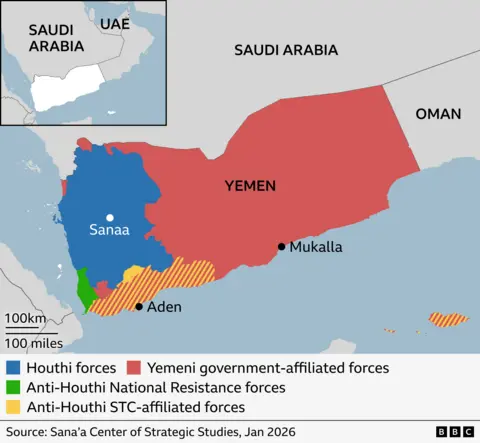
    Map showing how Yemeni government-affiliated forces now control most of the east of Yemen, including Mukalla which is on the southern coast. A section in the west, including the capital Sanaa, is controlled by Houthi forces.

    His government’s decision to give access to international media comes as the rift between Saudi Arabia and the UAE is widening.

    Their long-strained relationship deteriorated in December when UAE-backed southern separatists, the Southern Transition Council (STC), seized territory controlled by government forces in two western provinces.

    Saudi Arabia then carried out a strike on what it said was a shipment of weapons from the UAE to the STC in Mukalla, and backed a demand from Yemen’s presidential council for Emirati forces to leave the country immediately.

    The UAE withdrew and within days government forces and their allies retook control of the western provinces as well as all of the south.

    However, remaining separatists threaten the government’s position in some places, including the southern port of Aden.

    The UAE denied that the shipment had contained weapons and also Saudi allegations that it was behind the STC’s recent military campaign.

    Detainees ‘still held’
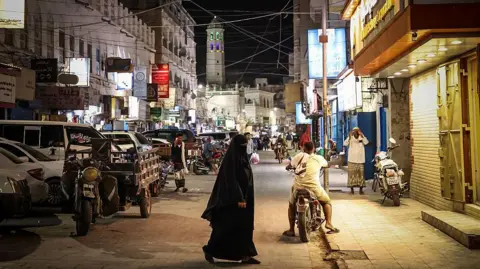
    Fadel SENNA / AFP via Getty Images A woman clad in black walks in a street with buildings on both sides , with a man on a motorbike behind her and a mosque minaret in the backgroundFadel SENNA / AFP via Getty Images

    Mukalla was controlled by forces allied to the UAE until early January

    On 12 January 2026, the president of Yemen’s Presidential Leadership Council, which oversees the government, Rashad al-Alimi, ordered the closure of all “illegal” prisons in southern provinces previously controlled by the STC, demanding the immediate release of those “held outside the framework of the law”.

    Eryani said some detainees had been discovered inside the facilities, but did not give numbers or further details.

    Some relatives – including the mother of the athlete – told the BBC that detainees have since been transferred to prisons now nominally under government control.

    Yemeni authorities say transferring prisoners into the formal justice system is complex, while rights groups warn arbitrary detention may simply continue under different control.

    “The terrorists are out on the streets,” the mother said.

    “Our sons are not terrorists.”


    Source link

  • What natural resources does the island have?

    What natural resources does the island have?


    Archie Mitchelland

    Danielle Kaye,Business reporters

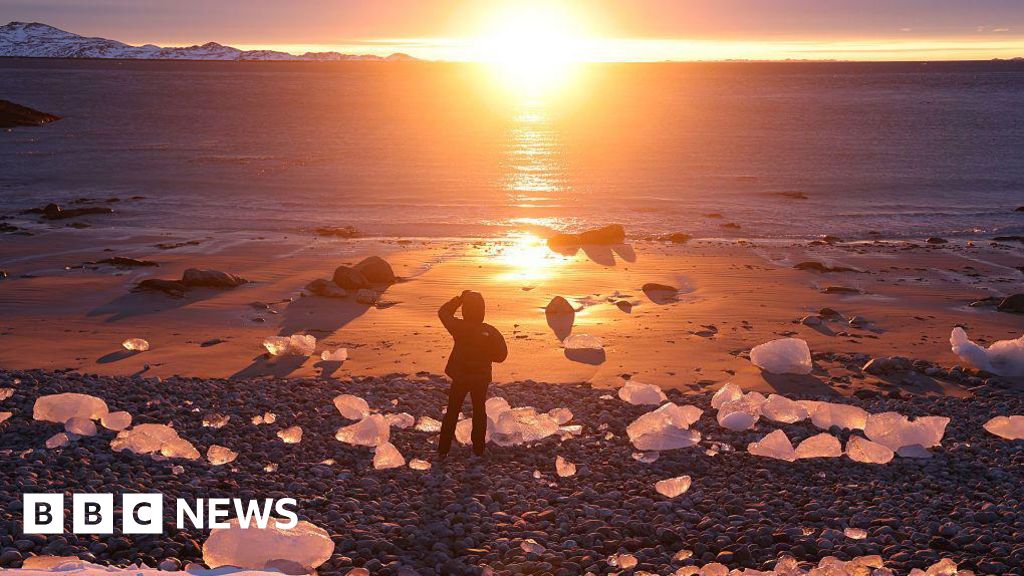
    Getty Images A person stands on a beach at sunset among chunks of ice washed up on the shore in Nuuk, Greenland.Getty Images

    Donald Trump has made clear he covets Greenland.

    Now he claims to have secured the “framework” of a future deal, to address defence on the island – a deal that he says includes rights to rare earth minerals.

    So what natural resources does Greenland have?

    Greenland is believed to sit on top of large reserves of oil and natural gas.

    It is also said to be home to the vast majority of raw materials considered crucial for electronics, green energy and other strategic and military technologies – to which Trump has been pushing to secure America’s access.

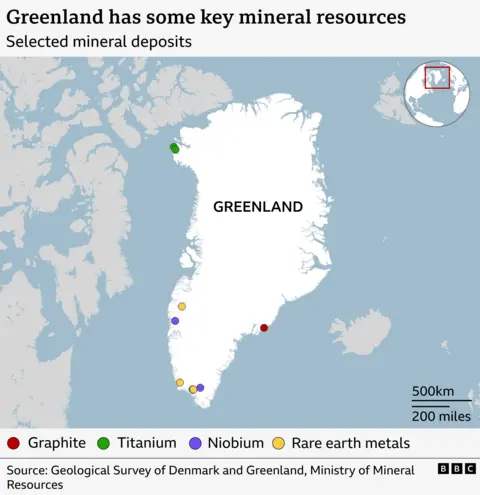
    Overall, 25 of 34 minerals deemed “critical raw materials” by the European Commission are found in Greenland, including graphite, niobium and titanium, according to the 2023 Geological Survey of Denmark and Greenland.

    Greenland’s strategic importance is “not just about defence”, Senator Ted Cruz, a Republican from Texas, said at a Senate hearing last year about the potential acquisition of Greenland, pointing to the island’s “vast reserves of rare earth elements”.

    Map of Greenland showing selected mineral deposits. Green dots in the north west of the island represent titanium, purple dots in the south west represent niobium, one yellow dot in the south east represents graphite, and yellow dots in the south west represent rare earth metals.

    Trump has sometimes downplayed the importance of those resources, pointing to what he claims is rising Russian and Chinese influence in the region to justify his claims that the US has to “have” the island.

    “I want Greenland for security – I don’t want it for anything else,” he told reporters at the World Economic Forum in Davos on Wednesday, pointing in part to the difficulty of exploring in the Arctic region. “You have to go 25ft down through ice to get it. It’s not, it’s not something that a lot of people are going to do or want to do.”

    But access to the island’s natural resources have loomed large in the background for the administration, which has put the US economy at the centre of its geopolitical vision and has made combatting China’s dominance of the rare earths industry a priority.

    Trump’s interest in controlling Greenland is “primarily about access to those resources, and blocking China’s access”, according to Steven Lamy, professor of international relations at the University of Southern California.

    Even before Trump’s second term, the US had been tightening its ties with Greenland, including by reopening its consulate in the island’s capital, Nuuk, in 2020, responding to Russia and China’s expanding military presence in the Arctic.

    Since Trump returned to office, his allies have talked up the island’s commercial potential, as rising temperatures expand sea routes and opportunities to explore the region’s fisheries and other natural resources, especially those related to defence, such as energy and critical minerals, that the administration sees as a priority.

    “This is about shipping lanes. This is about energy. This is about fisheries. And, of course, it’s about your mission, which is keeping us safe and monitoring space, monitoring our adversaries, and making sure the American people can sleep safely in their homes, day in and day out,” Mike Waltz, the current US ambassador to the United Nations and then Trump’s national security adviser, told US troops stationed in Greenland last year.

    And Louisiana Governor Jeff Landry told CNBC this month that Trump was a “business president” who believed the island represented “a more robust trading opportunity”.

    Over the summer, the Trump administration signed off on the possibility of backing an American company’s mining project in Greenland, via $120m (£90m) in financing from the Export-Import Bank of the United States.

    The plan built on other deals the Trump administration has agreed with Australia and Japan, as well as private firms, to secure US access to supply and production of rare earths, an industry now dominated by China.

    Dr Patrick Schröder, a senior research fellow at Chatham House, said the scale of Greenland’s critical minerals holdings had the potential to “shift the dial” for the US, allowing it to reduce its reliance on China – a key priority for the administration.

    But critics of Trump’s designs on the island, say it is not clear why US control would be necessary to access the island’s resources.

    Analysts also warn that tapping them is easier said than done.

    Among other challenges, mining in Greenland currently is expensive and hampered by severe weather conditions, a lack of infrastructure and a small labour force, Lamy said.

    While exploration permits have been given for 100 blocs of the island, there are just two productive mines in Greenland.

    “Greenland has been trying to attract outside investments into its extractive industries for a long time, and has not had a lot of luck because the business case just hasn’t really been there,” said Mikkel Runge Olesen, a senior researcher at the Danish Institute for International Studies.

    “It’s true that there are huge quantities of minerals of various kinds in Greenland. However, it also costs a lot of money to extract those minerals.”

    But Prof Andrew Shepherd, director of the Centre for Polar Observation and Modelling, said rapidly melting layers of ice are increasingly easing the process, exposing rock for potential mining and creating river runoff.

    “Getting all the fieldwork done traditionally has been very hard to do because you have to get energy to remote regions,” he told the BBC.

    “With the melting ice, you get the potential for hydro power in the area where the land is being exposed… so this presents itself as an interesting prospect.”

    Jennifer Spence, director of the Arctic Initiative at the Harvard Kennedy School, said when it came to mining in Greenland, “it’s all still about potential”.

    Still, she thinks the island’s strategic shipping location and rare earths deposits were key factors drawing Trump’s attention.

    “His logic is that there’s a national security imperative,” Spence said. “My belief is that this is much more economically driven.”

    Additional reporting by Natalie Sherman


    Source link

  • Nelson Mandela’s personal items can be sold after daughter wins South Africa court battle

    Nelson Mandela’s personal items can be sold after daughter wins South Africa court battle


    A South African court has dismissed an appeal by the country’s heritage body to stop the sale and export of various artefacts connected to anti-apartheid hero Nelson Mandela.

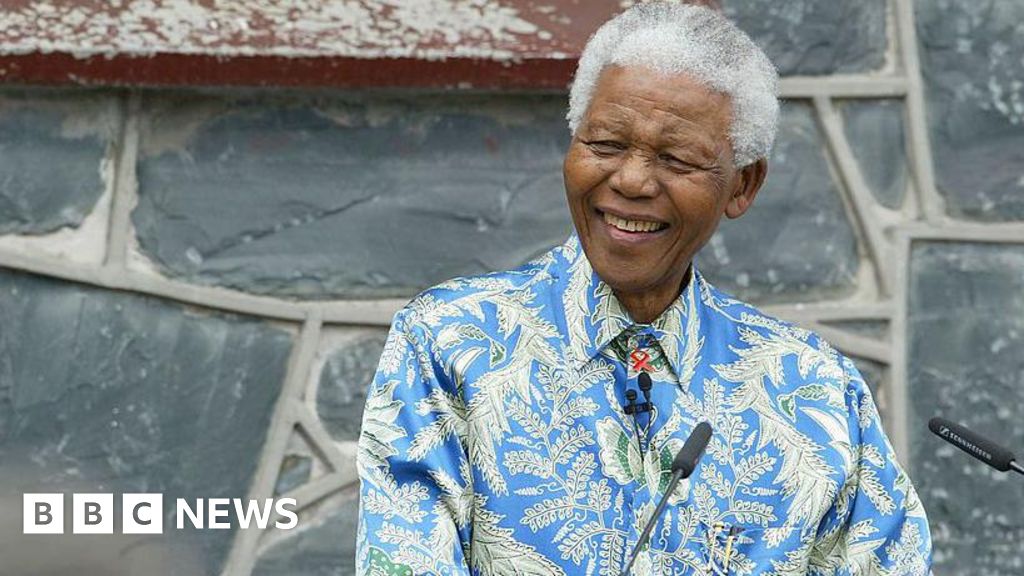
    The 70 personal items include a cell key from Robben Island, where Mandela was imprisoned for 18 of the 27 years he was locked up, a pair of Aviator sunglasses and one of his signature floral shirts. They were due to be exported to the US for auction.

    The objects belong to his eldest daughter, Makaziwe Mandela and Christo Brand, a Robben Island warden during Mandela’s incarceration.

    In trying to stop their sale, the authorities said they were part of the country’s heritage and were therefore legally protected from export.

    The South African Heritage Resources Agency (Sahra) first found out about the potential sale in a British newspaper article from late 2021, claiming that the key would go for more than £1m ($1.35m).

    The agency then wrote to the US auction house, Guernsey, that was planning the sale to ask it to suspend the auction and return the assets to South Africa.

    Other items in the lot were a copy of the 1996 South African Constitution personally signed by Mandela, one of his charcoal drawings, an ID card, a tennis racquet he used on Robben Island and gifts from world leaders, including one from former US President Barack Obama and his wife Michelle.

    Mandela’s daughter wanted to use the proceeds from the sale to build a memorial garden at the late former resident’s grave in Qunu, in Mthatha, Eastern Cape province.

    In its ruling, the Supreme Court of Appeal argues that Sahra’s interpretation of what items fell under the National Heritage Resources Act was overly broad.

    The ruling also states that whereas Makaziwe and Brand explained in detail why their respective assets were not heritage objects, Sahra made no attempt to explain on what grounds it believed they were.

    It is not yet clear whether the authorities will seek other legal avenues to block the sale. The BBC has contacted the sport, arts and culture department for comment.

    Makaziwe, Mandela’s only daughter with his first wife, welcomed the Supreme Court’s judgment, blasting the heritage agency for presuming “to know my father’s last wishes better than those who were beside him at the end – his family”.

    “Nobody is more invested in ensuring Tata’s [Mandela’s] legacy endures in the way he would want to be remembered than those who carry his name,” she said.

    She added that no decision had yet been made on what would happen to the items meant to go on auction.

    Some supporters of the government’s position argued that items connected to Mandela should not be sold or exported but instead kept in South Africa for future generations.

    Others believe that Mandela’s family should decide what happens to the objects.

    Mandela died in 2013 at the age of 95. He led the African National Congress in its struggle against apartheid – a system of legally enforced racism – and was released from prison in 1990.

    He was awarded the Nobel Peace Prize in 1993 along with then-President FW de Klerk.

    Mandela became South Africa’s first democratically elected president in 1994.


    Source link