Category: Uncategorized

  • Trump is shaking the world order more than any president since WW2

    Trump is shaking the world order more than any president since WW2


    Lyse DoucetChief international correspondent

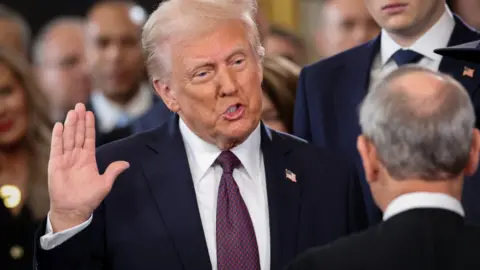
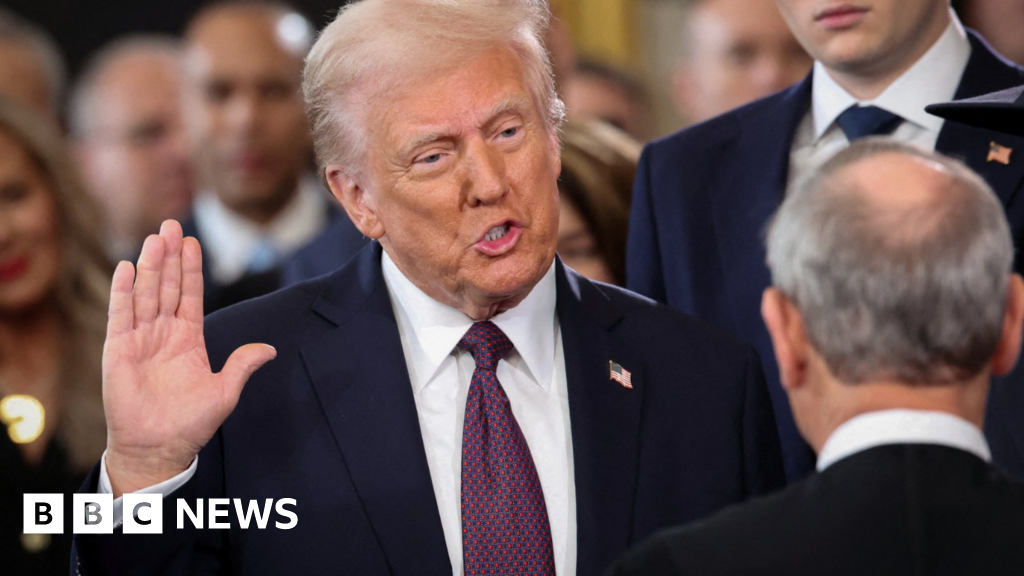
    Reuters The US President Donald Trump takes oath on the day of his Presidential Inauguration at the Rotunda of the US Capitol in Washington in January 2025.Reuters

    Tuesday marks one year to the day Trump was inaugurated as president for his second term

    On day one, he put the world on notice.

    “Nothing will stand in our way,” President Donald Trump declared, to thunderous applause, as he ended his inauguration speech in a cold Washington winter on this day last year, at the start of his second term.

    Did the world fail to take enough notice?

    Tucked into his speech was a mention of the 19th Century doctrine of “manifest destiny” – the idea that the US was divinely ordained to expand its territory across the continent, spreading American ideals.

    At that moment, the Panama Canal was in his sights. “We’re taking it back,” Trump announced.

    Now that same declaration, expressed with absolute resolve, is directed at Greenland.

    “We have to have it,” is the new mantra. It’s a rude awakening in a moment fraught with grave risk.

    US history is littered with consequential and controversial American invasions, occupations, and covert operations to topple rulers and regimes. But, in the past century, no American president has threatened to seize the land of a longtime ally and rule it against their people’s will.

    No US leader has so brutally broken political norms and threatened long-standing alliances which have underpinned the world order since the end of World War Two.

    There’s little doubt that old rules are being broken, with impunity.

    Trump is now being described as possibly the US’s most “transformative” president – cheered by supporters at home and abroad, alarm among others in capitals the world over, and a watchful silence in Moscow and Beijing.

    “It’s a shift toward a world without rules, where international law is trampled underfoot, and where the only law which seems to matter is the strongest with imperial ambitions resurfacing,” was French President Emmanuel Macron’s stark warning on the stage at the Davos Economic Forum, without directly mentioning Trump by name.
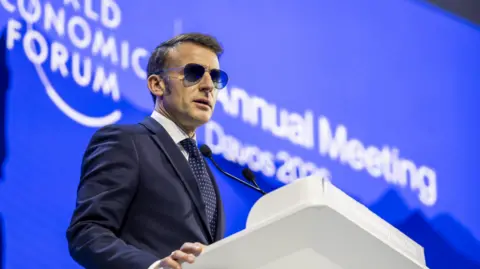
    EPA/Shutterstock French President Emmanuel Macron speaks during a plenary session at the Congress Hall during the 56th annual meeting of the World Economic Forum (WEF) in DavosEPA/Shutterstock

    French President Emmanuel Macron spoke at the World Economic Forum on Tuesday but avoided any direct mention of Trump

    There is mounting concern over a possible painful trade war, even worry in some circles that the 76-year-old Nato military alliance could now be at risk if, in the worst case scenario, the US commander-in-chief tries to take Greenland by force.

    Trump’s defenders are doubling down in support of his “America First” agenda, against the post-war multilateral order.

    When asked on BBC Newshour whether seizing Greenland would violate the UN charter, Republican congressman Randy Fine said: “I think the United Nations has abjectly failed in being an entity that supports peace in the world and, frankly, whatever they think, probably doing the opposite’s the right thing.”

    Fine introduced a bill called “Greenland Annexation and Statehood Act” in Congress last week.

    How do America’s anxious allies respond, when it seems nothing will stand in Trump’s way?

    Many phrases have peppered this past year of diplomatic contortions over how best to deal with the US’s unpredictable president and commander-in-chief.

    “We need to take him seriously but not literally,” comes from those who insist this can all be sorted out through dialogue.

    It’s worked, but only to a point, on trying to forge a united response with Europe to Russia’s blistering war in Ukraine.

    Trump often veers, from one week to the next, from espousing positions close to Russia’s, then tilting towards Ukraine, then bolting back into Russia’s orbit again.

    “He’s a real estate mogul,” says those who see in Trump’s maximalist positions his deal-making tactics from his New York property days.

    There’s an echo of that in his repeated threats of military action against Iran – although it’s clear military options are still on his now crowded table.

    He doesn’t talk like a traditional politician,” explains his top diplomat, the US Secretary of State Marco Rubio when he is repeatedly questioned about Trump’s tactics. “He says and then he does,” is his highest praise for his president against what he derides as the dismal record of previous incumbents.

    Rubio has been one of the principal voices trying to backpedal Trump’s threats on Greenland, underlining that he wants to buy this vast strategic ice sheet, not invade it.

    He pointed out that Trump has been exploring options to purchase the world’s largest island, to counter threats from China and Russia, since his first term in office.

    But there is no denying Trump’s bully tactics, his contempt for collective action, his belief that might is right.

    “He is a man of transactions and brute power, mafia style power,” says Zanny Minton Beddoes, editor-in-chief of the Economist magazine.

    “He doesn’t see the benefit of alliances, he doesn’t see the idea of America as an idea, a set of values; he doesn’t give two hoots about that.”

    And he doesn’t hide it.

    “Nato is not feared by Russia or China at all. Not even a little bit,” Trump told the New York Times in a wide-ranging interview earlier this month. “We’re tremendously feared.”

    If security was the issue, the US already has forces on the ground in Greenland and under a 1951 agreement could send in more troops and open more bases.

    “I need to own it,” is how Trump flatly puts it.

    And he often makes it clear, “I like to win.” There’s a growing body of proof that’s what it is about.

    His policy back flips in the past year have been baffling.

    Reuters Caps with slogans supporting Greenland placed on a shelf. The slogans on the caps include "Not for SALE!" and "Already Great".Reuters

    Merchandise opposing a US takeover of Greenland, a semi-autonomous territory of Denmark, have appeared in shops in Copenhagen

    In the Saudi capital Riyadh in May, we watched how his major speech on his first foreign trip of his second term met a rapturous reception.

    Trump took aim at the American “interventionists” whom he excoriated for having “wrecked far more nations than they built… in complex societies that they did not even understand themselves.”

    In June when Israel attacked Iran, Trump reportedly warned Israel’s Prime Minister Benjamin Netanyahu not to put his diplomacy at risk with his military threats against Tehran.

    By the end of the week, when he saw Israel’s success in assassinating top nuclear scientists and security chiefs, Trump exclaimed: “I think it’s been excellent.”

    “Sane-washing” was the phrase coined months ago by Edward Luce of the Financial Times to describe the world’s polite portrayals of Trump, the succession of leaders landing at his door with glittering gifts and gilded praise to try to win him over to their side.

    “Trump’s apologists – a more numerous crowd than true believers – work round the clock to sane-wash his policies into something coherent,” Luce wrote in his latest column.
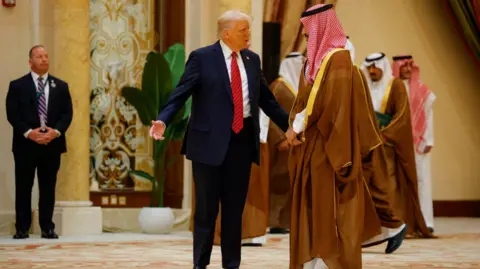
    Reuters  Donald Trump gestures next to Saudi Crown Prince Mohammed Bin Salman. Trump wears a dark suit and red tie, while the prince is in a long, brown robe.Reuters

    Trump met Saudi Crown Prince Mohammed Bin Salman in Riyadh in May 2025

    It was on full display last October when leaders the world over were summoned to join him at the Egyptian Red Sea resort of Sharm El-Sheikh to celebrate his ringing declaration that “at long last we have peace in the Middle East” for the first time in “3,000 years.”

    The first significant phase of his peace plan had brought about a desperately needed ceasefire in Gaza and the urgent release of Israeli hostages.

    It was Trump’s muscular diplomacy that forced Netanyahu, as well as Hamas, to agree to it. It was a major breakthrough only Trump could achieve.

    But it wasn’t – sadly – the dawn of peace. No-one there said the quiet part out loud.

    Last year Trump’s approach was framed as manifest destiny. This year it’s the early 19th Century Monroe Doctrine now updated, since the Venezuela invasion, as the “Donroe Doctrine.”

    President Trump now owns it, bolstered by his fervent backers on his team, with his belief that America can act at will in its backyard, and beyond, to protect American interests.
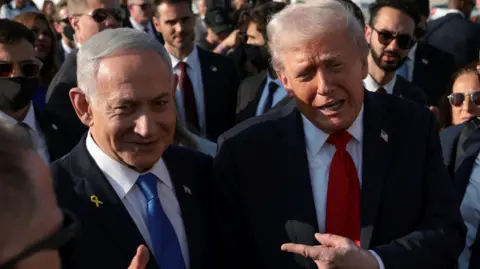
    Reuters US President Donald Trump gestures next to Israeli Prime Minister Benjamin Netanyahu at Ben Gurion International Airport as Trump leaves Israel en route to Sharm El-Sheikh in October 2025.Reuters

    In October, Benjamin Netanyahu called Trump the “greatest friend” Israel had ever had in the White House

    Sometimes he is called an isolationist, sometimes an interventionist. But there’s always that slogan which returned him to power – Make America Great Again.

    And his letter to Norway’s Prime Minister Jonas Gahr Støre highlighted his obsessive pique over not winning this year’s Nobel Peace Prize.

    Trump informed Støre: “I no longer feel an obligation to think purely of peace, although it will always be predominant, but can now think about what is good and proper for the United States of America.”

    “It’s a good day to have a Nordic temperament,” Norway’s Foreign Minister Espen Barth Eide diplomatically remarked to me when I asked about this moment.

    Norway has been calm, with ice-hard firmness, in its defence of Greenland and Denmark and collective security in the Arctic.

    European responses still stretch across this slippery political ice.

    Macron has vowed to launch the EU’s “trade bazooka” of counter-tariffs and restricting access to the EU’s lucrative market.

    Italian Prime Minister Giorgia Meloni, one of the American president’s closest European allies, has vaguely spoken of a “problem of understanding and miscommunication.”

    UK Prime Minister Sir Keir Starmer has strongly and publicly defended Greenland’s territorial integrity but wants to protect the strong personal bond he’s built over the past year by avoiding retaliatory tariffs.
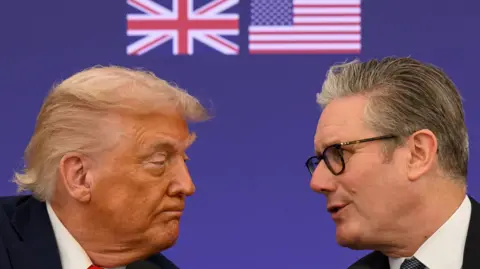
    Reuters US President Donald Trump and British Prime Minister Sir Keir Starmer announce an agreement between the two countries as they hold a press conference at Chequers in September 2025.Reuters

    Sir Keir Starmer has maintained a largely cordial relationship with Trump since he started his second term as president

    The gloves are off for Trump as he posts the private messages he’s receiving from leaders using the old tools of statecraft to try to keep him on side.

    “Let us have a dinner in Paris together on Thursday before you go back to the US,” suggested the French president who also queried, in the midst of praise for other foreign policy successes, “I do not understand what you are doing on Greenland”.

    “Can’t wait to see you”, wrote Nato Secretary General Mark Rutte, who once called Trump “daddy” for his forceful handling of the Iran-Israel 12-day war last year.

    Nato boss commends ‘daddy’ Trump’s handling of Israel-Iran conflict

    Rutte, and others, have credited Trump’s blunt threats for forcing Nato members to significantly increase their defence spending in recent years.

    Trump’s warnings, going back to his first term, accelerated a trend called for by previous US presidents and started by Nato members themselves in the shadow of Russian threats.

    On the other side of the Atlantic, the country which has long lived in America’s shadow has been trying to forge a different path forward, albeit with challenges of their own.

    “We have to take the world as it is, not the way we want it to be,” was the candid reflection of Canada’s Prime Minister Mark Carney on his trip to China last week.

    It was the first visit by a Canadian leader to Beijing since 2017, after years of sharp tension, and it sent a clear signal of this fast changing world.

    Watch: Canada-China trade relationship “more predictable” than with US, says Carney

    Trump’s astonishing threat to annex his neighbour to the north surfaced again this week in a post on social media which showed the western hemisphere, including Canada and Greenland, covered in stars and stripes.

    Canadians know there’s still a risk they could be next.

    Carney, the former central banker, rose to Canada’s highest office last year buoyed by Canadians’ belief he was the best prepared to take on Trump.

    He responded “dollar for dollar” from the start, imposing retaliatory tariffs – until it became too painful for the much smaller Canadian economy, which sends more than 70% of its trade south of its border.

    When Carney took to the stage at Davos on Tuesday, he also focused on this jarring juncture.

    “American hegemony in particular, helped provide public goods, open sea lanes, a stable financial system, collective security and support for frameworks for resolving disputes,” he said, adding bluntly: “We are in the midst of a rupture, not a transition.”

    On Wednesday Trump will speak from that same podium with the world watching.

    Asked by the New York Times this month what could stop him, Trump replied: “My own morality. My own mind. It’s the only thing that can stop me.”

    That’s what lies behind an armada of allies now seeking to persuade, flatter, force him – to change his mind.

    This time, it’s not certain they will succeed.


    Source link

  • UK defends Chagos Islands deal after Trump calls handover ‘act of great stupidity’

    UK defends Chagos Islands deal after Trump calls handover ‘act of great stupidity’


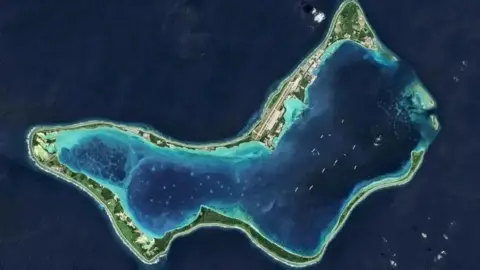
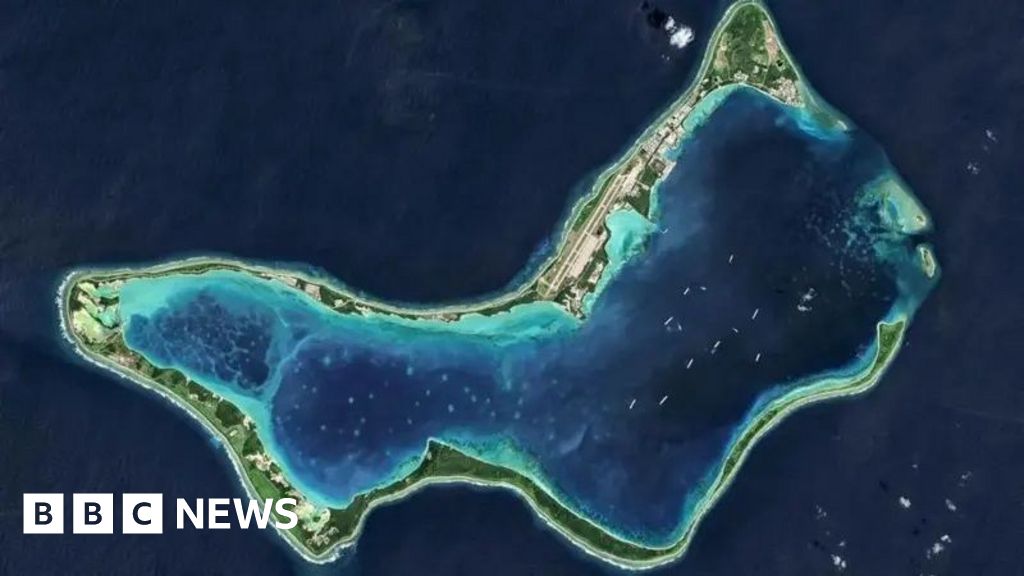
    Getty Images Aerial view of the Chagos IslandsGetty Images

    The UK government has defended a deal to give the Chagos Islands to Mauritius and lease back a key military base, following criticism from US President Donald Trump over its handling.

    In a post on social media, Trump labelled the move as an “act of great stupidity” and “total weakness”, months after he and senior US officials endorsed it.

    In response, the UK government said it would “never compromise on our national security”, while the prime minister’s official spokesperson insisted the US still supported the move.

    The UK signed the £3.4bn ($4.6bn) agreement in May, under which it would retain control of a UK-US military base on the largest of the islands, Diego Garcia.

    In a post on his Truth Social platform on Tuesday morning, Trump said: “Shockingly, our ‘brilliant’ NATO Ally, the United Kingdom, is currently planning to give away the Island of Diego Garcia, the site of a vital U.S. Military Base, to Mauritius, and to do so FOR NO REASON WHATSOEVER.

    “There is no doubt that China and Russia have noticed this act of total weakness.”

    He added: “The UK giving away extremely important land is an act of GREAT STUPIDITY, and is another in a very long line of National Security reasons why Greenland has to be acquired.”

    Responding, the prime minister’s official spokesman said that the US supports the deal and “the president explicitly recognised its strength last year”.

    He added that it was also backed by the UK’s Five Eyes allies, the other members of which – besides the UK and US – are Canada, Australia, and New Zealand.

    Asked if he could categorically say the Chagos deal would go ahead, even though it is still going through Parliament, the spokesman said: “Yes. Categorically, our position hasn’t changed.”

    Earlier, a UK government spokesperson said it had acted “because the base on Diego Garcia was under threat after court decisions undermined our position and would have prevented it operating as intended in future”.

    They added that the agreement had secured the operations of the joint US-UK military base “for generations, with robust provisions for keeping its unique capabilities intact and our adversaries out”, and noted the deal had been welcomed by allies including the US.

    UK Foreign Office minister Stephen Doughty later said the government “will of course have discussions with the [Trump] administration in the coming days to remind them of the strength of this deal and how it secures the base”.

    Mauritius’ attorney general Gavin Glover has said he still expects the agreement to go ahead.

    In a statement he said it was “important to remember” that the deal was “negotiated, concluded and signed exclusively between the United Kingdom and the Republic of Mauritius”.

    He added: “The sovereignty of the Republic of Mauritius over the Chagos Archipelago is already unambiguously recognised by international law and should no longer be subject to debate.”

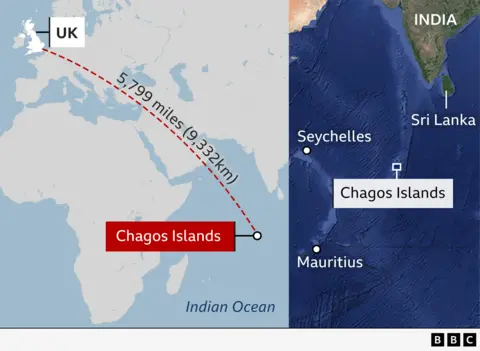
    The image shows two maps. One map shows the distance of the Chagos Islands to the UK. The other map shows the Chagos Islands in relation to the coast of Africa, India and Southeast Asia.

    The agreement followed a long-running dispute between the UK and Mauritius – a former British colony – about sovereignty over the Chagos Islands.

    The Chagos Islands were separated from Mauritius in 1965, when Mauritius was still a British colony. Britain purchased the islands for £3m, but Mauritius has argued that it was illegally forced to give them away as part of a deal to gain independence.

    Under the deal agreed in May last year, the UK would hand over sovereignty of the islands to Mauritius, while retaining control of the military base on Diego Garcia.

    It would lease back Diego Garcia for a period of 99 years – at an average cost of £101m a year. Prime Minister Sir Keir Starmer said that was necessary to protect the base from “malign influence”.

    Before signing the deal, the UK offered Trump an effective veto, because of its implications for US security.

    Allies of the president had criticised the plan, but during a meeting with Sir Keir in the Oval Office last February, Trump said “I think we’ll be inclined to go along with your country”.

    After the agreement was signed in May, US Secretary of State Marco Rubio said in a statement that Washington “welcomed” the deal.

    He said it secured the “long-term, stable, and effective operation of the joint US-UK military facility at Diego Garcia”, which he described as a “critical asset for regional and global security.”

    Rubio added that “President Trump expressed his support for this monumental achievement during his meeting with Prime Minister Starmer at the White House.”

    A government bill to implement the agreement between the UK and Mauritian governments is currently in its final stages.

    On Tuesday, Conservative leader Kemi Badenoch said in a post on X that the prime minister now had “the chance to change course on Chagos”.

    She said that “paying to surrender the Chagos Islands is not just an act of stupidity, but of complete self sabotage”.

    Reform UK leader Nigel Farage, who has long been a critic of the deal, said in a post on X: “Thank goodness Trump has vetoed the surrender of the Chagos islands”.

    Liberal Democrats leader Sir Ed Davey said Trump’s comments showed Sir Keir’s approach to the US president “has failed”.

    “The Chagos Deal was sold as proof the government could work with him, now it’s falling apart,” Davey said in a post on X.

    “It’s time for the government to stand up to Trump; appeasing a bully never works.”

    Labour MP and chair of the Foreign Affairs Committee, Emily Thornberry, told BBC Radio 4’s Today programme that while the UK should take Trump “seriously”, it should not take his comments “literally”.

    She described his comments on Tuesday as an example of “presidential trolling”, saying she was “in favour of keeping calm and trying to sit this out”.

    Two British Chagossian women born on Diego Garcia – Bernadette Dugasse and Bertrice Pompe – want the right to return to their place of birth and say they were excluded from discussions over the deal.

    Pompe told the BBC she views the US president’s criticism of the deal as a “good thing” but “only words”.

    Over WhatsApp, Dugasse said: “I want the deal to stop and not [see] money [given] to the Mauritius government.”

    She said Chagossians should be allowed to “sit at the table and decide our future”.

    Additional reporting by Alice Cuddy


    Source link

  • New truce in Syria as Kurdish-led forces leave camp for IS families

    New truce in Syria as Kurdish-led forces leave camp for IS families


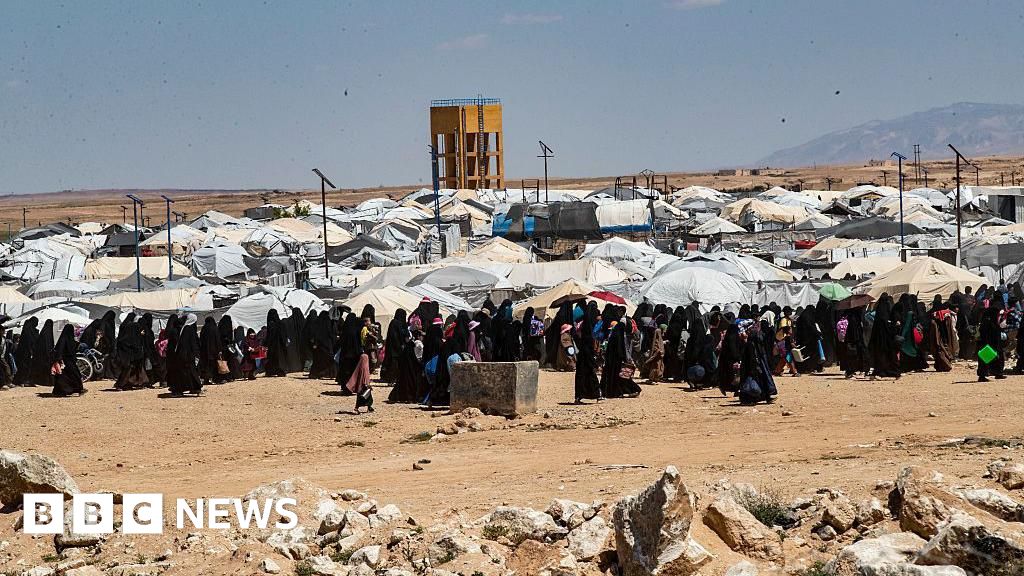
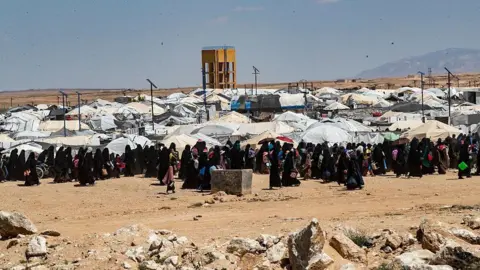
    AFP File photo showing people walking around al-Hol camp, in Hassakeh province, north-eastern Syria (18 April 2025)AFP

    About 20,000 people with alleged links to IS are held in al-Hol camp

    Syria’s government has announced a new ceasefire with the Kurdish-led Syrian Democratic Forces (SDF), after the militia alliance withdrew from a camp holding thousands of people with alleged links to the jihadist group Islamic State (IS).

    The SDF said its forces were “compelled” to leave al-Hol camp and redeploy to other cities in north-east Syria “due to the international indifference toward the issue of [IS]”.

    Syria’s interior ministry complained that it took place without co-ordination with the government or US-led coalition against IS.

    Later, the presidency said it had reached an “understanding” with the SDF on the future of Hassakeh province, which has a large Kurdish population.

    A statement said the SDF would be given four days to carry out consultations on a detailed plan for the peaceful integration of areas under its control into the state.

    The presidency also promised that government forces would not enter the cities of Hassakeh and Qamishli, or any Kurdish villages.

    At the same time, the SDF declared its “full commitment to the ceasefire” and said its forces would not initiate any military action unless they were attacked.

    The SDF also said it was ready to “move forward with implementing” the deal reached with the government on Sunday that was supposed to end almost two weeks of fighting.

    The agreement should see the Kurdish-run autonomous region in the country’s north-east and its key infrastructure brought under government control, as well as the integration of the tens of thousands of SDF fighters into the defence and interior ministries’ forces.

    It represents a major blow for the SDF, which had been reluctant to give up the autonomy that it won for Syria’s Kurdish minority when helping US-led coalition forces defeat IS militarily during the country’s 13-year civil war.

    Interim President Ahmed al-Sharaa has vowed to reunify Syria since he led the rebel offensive that overthrew Bashar al-Assad in December 2024, but the country remains deeply divided and has been rocked by waves of deadly sectarian violence.

    The SDF announced its withdrawal from al-Hol camp as Syrian army and interior ministry forces advanced deep into Hassakeh province after taking control of Deir al-Zour and Raqqa.

    “Due to the international indifference toward the issue of the IS terrorist organisation and the failure of the international community to assume its responsibilities in addressing this serious matter, our forces were compelled to withdraw from al-Hol camp and redeploy in the vicinity of cities in northern Syria that are facing increasing risks and threats,” it said.

    In a statement sent to Kurdish news agency Hawar, SDF commander Mazloum Abdi urged the US-led coalition – once his main ally – to “bear its responsibilities in protecting facilities”.

    “We withdrew to predominantly Kurdish areas and protecting them is a red line,” he added.

    The Syrian interior ministry said the SDF units had pulled out of al-Hol without any co-ordination in an “attempt to pressure the government over the fight against terrorism”.

    The ministry added that it was “taking all necessary measures in co-ordination and co-operation with the international coalition to maintain security and stability”.

    The defence ministry also said it was ready to assume control of the camp as well as all prisons holding suspected IS fighters in the region.

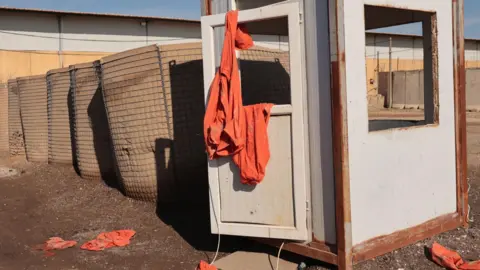
    EPA Abandoned orange prisoners' uniforms at Shaddadi prison in Hassakeh province, north-eastern Syria (20 January 2026)EPA

    Prisoners’ uniforms were scattered on the ground at Shaddadi prison after government forces took control

    Before the fighting with the government erupted earlier this month, the SDF was holding about 8,000 suspected IS fighters at prisons in north-eastern Syria.

    Around 34,000 people linked to IS were also being detained at al-Hol and another camp, Roj, the UN reported last August. The population of the camps, of which 60% were children, comprised 6,700 Iraqis, 15,500 Syrians and 8,500 citizens of other countries, including the UK.

    The SDF, US and UN have long called for the repatriation of the foreign IS suspects and their families from north-eastern Syria, citing the political instability and dire conditions in the prisons and camps, but many countries have refused to take them.

    Earlier, the government and SDF traded accusations over the escape of suspected IS fighters from an SDF-run prison in Shaddadi, in southern Hassakeh province.

    The interior ministry said on Monday night that its special forces and army soldiers had entered the town following “the escape of around 120 [IS] terrorists” from the prison. Search operations by the security forces resulted in the arrest of 81 of the fugitives, it added.

    The SDF said it had lost control of Shaddadi prison in the afternoon after “Damascus-affiliated factions” mounted a series of attacks and killed of dozens of its fighters, who it said had been attempting to “prevent a serious security catastrophe”.

    SDF spokesman Farhad Shami said around 1,500 IS members had escaped during the clashes, according to Reuters news agency.

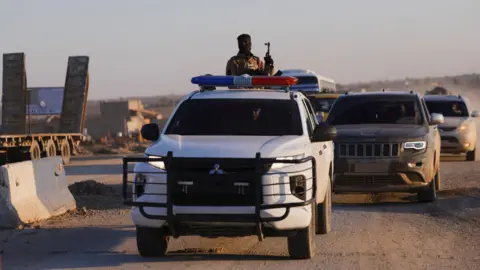
    Reuters Syrian government forces advance along a road in Hassakeh province, north-eastern Syria (20 January 2026)Reuters

    The government says it has given the SDF four days to formulate a plan on the future of Hassakeh province

    The SDF also accused government forces of attacking al-Aqtan prison, north of the city of Raqqa, which is holding IS members and leaders.

    On Tuesday, a statement said the prison’s buildings and facilities had been shelled and its water supply cut off. “These practices constitute a blatant violation of humanitarian standards and pose a serious threat to the lives of the detainees,” it warned.

    However, the defence ministry denied that there had been clashes in the vicinity of the prison.

    It said the facility was “fully secured”, with military police and internal security forces deployed around the facility and in contact with the administration to ensure supplies were provided.

    The US, which was once the SDF’s main ally in Syria, was monitoring developments in Syria with “grave concern”, a White House official said.

    “We urge all parties to exercise maximum restraint, avoid actions that could further escalate tensions, and prioritize the protection of civilians across all minority groups,” they added.

    Special envoy Tom Barrack meanwhile explained that the rationale for the US-SDF partnership had “largely expired”, and that his country was currently focused on ensuring the security of facilities holding IS prisoners and facilitating talks between the SDF and President Sharaa’s government on implementation of the ceasefire deal.

    “This moment offers a pathway to full integration into a unified Syrian state with citizenship rights, cultural protections, and political participation – long denied under Bashar al-Assad’s regime,” he wrote on X.

    After signing the deal with the SDF on Sunday, Sharaa said he hoped it would allow Syria to “end its state of division and move to a state of unity and progress”. However, Abdi said the fighting had been “imposed on us” and that he had accepted the deal “to stop the bloodshed”.


    Source link