Category: Uncategorized

  • Tragic chapter on the trains sends rail superpower Spain into crisis

    Tragic chapter on the trains sends rail superpower Spain into crisis


    Guy Hedgecoein Córdoba, Spain

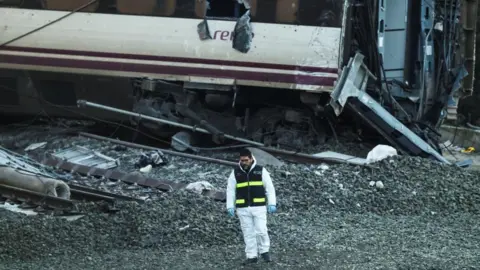
    Reuters A member of the Spanish Civil Guard stands near the wreckage of a train involved in the accident, at the site of a deadly derailment of two high-speed trains near AdamuzReuters

    “Since the high-speed line was built, 30-something years ago, we never had any problems, it worked perfectly and was fantastic,” says Alberto Montavez Montes, a shop-owner opposite Córdoba city hall, where the Spanish and Andalusian flags have been hanging at half-mast.

    Now, though things feel different: “It’s not that there’s psychosis, but it does make you just a bit reluctant to get on a train, without a doubt.”

    In just a few tragic days since two high-speed trains collided in this southern region of Spain, with the loss of 45 lives, it has felt that Spain’s much-vaunted rail system has been thrown into a sudden, deep crisis.

    EPA/Shutterstock People gather to observe a minute of silence in memory of the victims of the train collision that occurred on 18 January, in Punta Umbria, Huelva, Spain, on 20 January 2026EPA/Shutterstock

    Spaniards observed three days of mourning this week as they reflected on the Adamuz disaster

    Second only to China in scale, Spain has 3,900 km (2,400 miles) of high-speed (AVE) rail and until now its national network has been admired for its efficiency and safety.

    In 2009, then-US president Barack Obama singled out Spain for praise when he outlined a vision for the creation of a high-speed rail network across America. The line connecting Madrid and Seville “is so successful that more people travel between those cities by rail than by car and airplane combined”, he said.

    At the time a Spanish-led consortium had just begun work on a high-speed link across the Saudi Arabian desert, confirming the country’s status as a rail superpower.

    That reputation has been humbled this week.

    Last Sunday, the back three carriages of a train run by private Italian operator Iryo derailed at high speed, along a straight stretch of track, into the path of an oncoming train run by national rail operator Renfe which bore the brunt of the crash.

    Two days later, a trainee driver was killed when a wall collapsed on to a suburban rail line near Barcelona in the north-east after heavy rainfall, derailing a train.
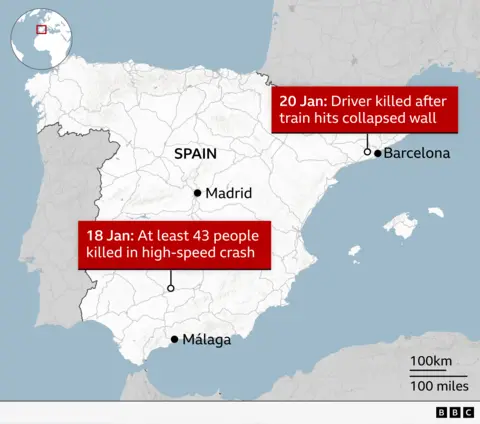
    Two deadly accidents in three days in southern and north-eastern Spain

    The same day another local train in Catalonia hit a rock, although nobody was injured.

    And on Thursday, several passengers on a narrow-gauge train suffered minor injuries when a crane struck a carriage.

    Train drivers in Catalonia refused to work in the wake of the accident near Barcelona, demanding safety guarantees and contributing to two days without local rail services in the region.

    Separately, train drivers’ union Semaf has called a nationwide strike for three days in February over what it has described as “the constant deterioration of the rail network”.
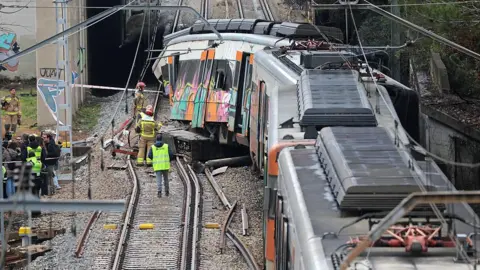
    NurPhoto via Getty Images A train derails in Gelida, Spain, on January 21, 2026, after colliding with a retaining wall that fell on to the track due to heavy rainNurPhoto via Getty Images

    A trainee driver was killed when a wall crashed on to his cab in Catalonia in heavy rain

    In addition, several high-speed lines have had their speed limits temporarily reduced, due to safety concerns.

    Throughout the week, delays, stoppages and other incidents affecting the rail system over recent months have been pored over in the media, while members of the public have aired grievances on social media about uncomfortable or alarming travel experiences.

    “I think the trains aren’t as safe as before,” says Olga Márquez, another resident of Córdoba. Her husband regularly travels to Madrid for work, on the same line on which the high-speed collision took place, and she says he has often mentioned vibrations and noises during the journey which suggested to her the track was not in optimum state.

    “I’m happy to get on a train, but when it comes to my husband, all this makes me think twice,” she says.
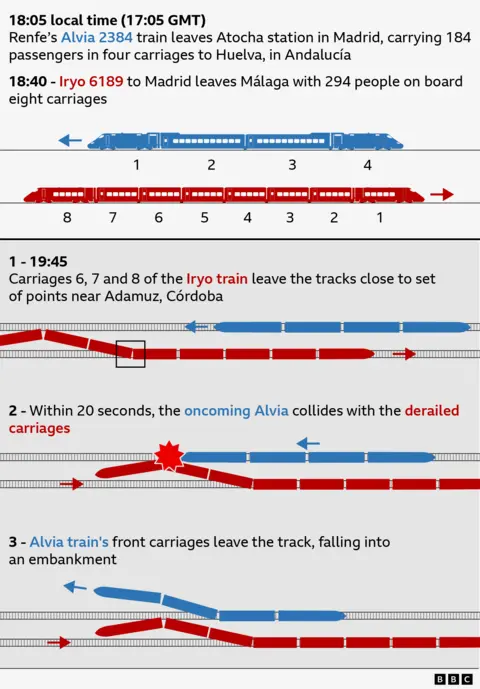
    Graphic showing how the train crash happened in Spain in three stages. The image shows the Renfe train is four carriages long and the Irya train is eight carriages long. Text says that at 18:05 local time (17:05 GMT), Renfe’s Alvia 2384 train (shown in blue) leaves Atocha station in Madrid, carrying 184 passengers in four carriages to Huelva, in Andalucía. At 18:40, Iryo 6189 to Madrid (shown in red) leaves Málaga with 294 people on board eight carriages. At 19:45, carriages 6, 7 and 8 of the Iryo train leave the tracks close to set of points near Admuz, Córdoba. Within 20 seconds, the oncoming Alvia collides with the derailed carriages. The Alvia train's front carriages leave the track, falling into an embankment.

    A long delay between the high-speed crash and the rail and rescue services’ realisation that two trains – rather than just one – had been involved has created doubts about the emergency response to such tragedies.

    The government, the civil guard and an independent commission all continue to investigate the Andalusia crash, although sabotage and human error appear to have been ruled out.

    Meanwhile politicians, commentators, and ordinary Spaniards have been debating the possible cause as well as highlighting weaknesses in Spain’s overall rail system.

    The amount of investment the rail network receives has come under particular scrutiny. The Socialist-led government has sought to dismiss such queries, pointing out, for example, that €700m (£605m) has been invested in updating the Madrid-Andalusia line in recent years, with the stretch of track where the accident took place included in that renovation.

    “We’re not looking at a problem of lack of maintenance, we’re not looking at a problem of obsolete [infrastructure], and we’re not looking at a problem of lack of investment,” said the transport minister Óscar Puente.
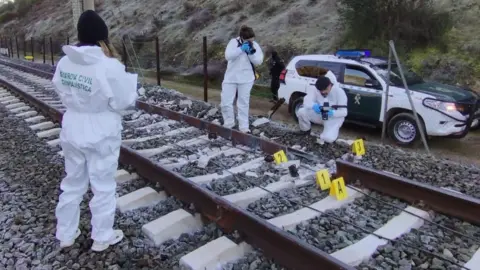
    Guardia Civil A handout photo released by the Spanish Civil Guard shows officers gathering evidence at the site of the Adamuz rail crashGuardia Civil

    Investigators believe the track already fractured before the Iryo train went over it

    A preliminary report by rail accident investigation commission CIAF has found that grooves found on the wheels of the derailed Iryo train and three earlier trains suggests that a fracture in the track occurred before the Iryo train went over it.

    Urging caution, Puente said he suspected “a problem that we have never seen on our network before.”
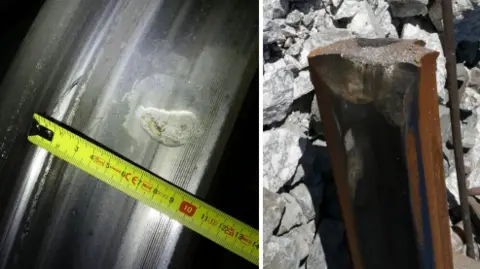
    CIAF Spain Two images show a groove on a train wheel on the left and on the right the possible point of collision where the track was brokenCIAF Spain

    Grooves were found on wheels of the Iryo train that had already passed over the track before the derailment

    Figures released by his ministry show a sharp increase in maintenance spending on the rail system since Prime Minister Pedro Sánchez took office in 2018. However, other data tells a different story: Spain was bottom of an index published by German railway association Allianz pro Schiene of spending per capita on rail infrastructure by 14 European countries in 2024.

    Salvador García-Ayllón, head of the civil engineering department at Cartagena’s University-Polytechnic, described the high-speed network as being “the jewel in the crown of Spanish infrastructure”.

    However, the liberalisation of the rail sector in 2020, allowing France’s Ouigo and Italy’s Iryo to provide high-speed services, may have increased competitivity and reduced ticket prices, but it has also put more pressure on the system.

    Around 22 million travellers currently use Spain’s high-speed trains each year, around double the number prior to the liberalisation, and 17 times the number of users in 1992, the year the Madrid-Seville line was inaugurated.

    Salvador García-Ayllón also points to new lines which have been built over recent years – including the north-western region of Galicia and the northern city of Burgos, with a new route along the Mediterranean under construction – whose upkeep presents a challenge. All of this, he said, has left Spanish rail “bursting at the seams”.

    “The challenge is not just to buy a Ferrari, you have to take the Ferrari to the garage,” he said. “You have to invest in maintaining the infrastructure you have.”

    The high-speed rail system’s reliability has dropped noticeably in recent years. In July of 2025, its trains were 19 minutes late on average, according to data provided by Renfe. Local rail has also seen a rise in incidences, such as delays, cancellations and technical problems, which have more than tripled since 2019 on the Madrid local Cercanías network.

    Catalonia, which suffered the double accident on Tuesday, has had longstanding and well-documented deficiencies in its suburban Rodalies network, which have fed into its political tensions with Madrid over the last decade.

    Perhaps inevitably, the recent tragedies have already spilled into the deeply divided political arena.

    Far-right party Vox has said that “travelling in Spain [by train] is no longer safe”, a claim that fits into its repeated insistence that the country is akin to a failed state. The main opposition People’s Party (PP), meanwhile, has accused the government of hiding information about the high-speed crash.

    The prime minister, Pedro Sánchez, has acknowledged that the accident in southern Spain caused “irreparable” damage. Yet he also insisted that the high-speed network “is the cause of pride for the country”. Not so long ago, few Spaniards would have queried that assertion. Now, many will find it hard to agree.


    Source link

  • ISC Stormcast For Thursday, January 22nd, 2026 https://isc.sans.edu/podcastdetail/9776

    ISC Stormcast For Thursday, January 22nd, 2026 https://isc.sans.edu/podcastdetail/9776


    (c) SANS Internet Storm Center. https://isc.sans.edu Creative Commons Attribution-Noncommercial 3.0 United States License.


    Source link

  • Stuck between the US and Russia, Canada must prove it can defend its Arctic territory

    Stuck between the US and Russia, Canada must prove it can defend its Arctic territory


    Canada’s Arctic is a massive, treacherous, and largely inhospitable place, stretched out over nearly 4 million square kilometres of territory – but with a small population roughly equal to Blackburn in England or Syracuse, New York.

    “You can take a map of continental Europe, put it on the Canadian Arctic, and there’s room to spare,” Pierre Leblanc, the former commander of the Canadian Forces Northern Area told the BBC. “And that environment is extremely dangerous.”

    Standing at the defence of that massive landmass is an aging string of early warning radars, eight staffed military bases and about 100 full-time Coast Guard personnel covering 162,000km of coast, about 60% of Canada’s total oceanfront.

    The Arctic region is the scene of intense geopolitical competition, bordered by Russia and the US on either side of the North Pole – and increasingly attractive to China, which has declared itself a “near Arctic state” and vastly expanded its fleet of naval vessels and icebreakers.

    Standing in the middle is Canada, whose population is a small fraction of the larger Arctic players.

    Nearly four years after Arctic security was thrust into the headlines following Russia’s invasion of Ukraine, the defence of Canada’s far north has again been brought to the forefront of public consciousness by Donald Trump’s designs on Greenland, a self-governing part of the Kingdom of Denmark that the White House says is vital to safeguarding the US from would-be enemies abroad.

    Canada’s Arctic has not gone unnoticed by the Trump administration, which has reportedly become increasingly concerned by perceived vulnerabilities to US adversaries, and in April signed an executive order underscoring American “commitment to ensuring both freedom of navigation and American domination in the Arctic waterways.”

    The Canadian government, for its part, has sought to reassure the US and Nato allies that it is doing its part to protect the region.

    Speaking at the World Economic Forum in Davos, Prime Minister Mark Carney said that Canada is working to secure “our shared objectives of security and prosperity in the Arctic” through “unprecedented” investments in radar systems, submarines, aircraft and “boots on the ground” in the region.

    Col Leblanc, who spent a total of nine years in the Canadian Arctic, said those investments have marked a “major shift” in Arctic security, noting that increases in Canadian defence expenditure – from 2% to 5% of GDP by 2035 – have meant “real action” in terms of additional over-the-horizon radar and aircraft dedicated to the Arctic.

    Much of this focus, he added, has been prompted by the Trump administration’s renewed focus on the Arctic and Greenland.

    “[That] certainly helps the Canadian government move in the right direction,” Leblanc added.

    Still, challenges persist, including limited port facilities and difficulties resupplying far-flung bases that are sometimes thousands of cold, empty miles apart.

    While Canada and other US Nato allies have opposed the Trump’s administration bid to “take over” Greenland to protect the Arctic, several experts who spoke to the BBC agreed with the administration’s broad assessment that additional defences in the region are urgently needed.

    Troy Bouffard, the director of the Fairbanks, Alaska-based Center for Arctic Security and Resilience, said that while on-the-ground cooperation between the US and Canada in the Arctic “remains the envy of the world”, much of the existing defence infrastructure was designed to combat Cold War-era threats, rather than existing ones.

    In particular, he warned of the prospect of hypersonic missiles that travel at least five times the speed of sound, making them much harder to detect and intercept than traditional ballistic missiles, which would follow predictable arcs over the North Pole.

    Such a threat is no longer theoretical.

    Russia has used hypersonic missiles in combat in Ukraine, including a January strike that saw the first operational use of the nuclear-capable “Oreshnik” missile that carries multiple warheads at approximately 10 times the speed of sound.

    “That technology has changed everything for us. We have to relook at the entire North American defence system and re-do it,” he said. “What exists right now cannot defend against hypersonic cruise missiles, at all. Like 0%.”

    Traditional ground-based radar systems, he added, “are not going to work” against these emerging technologies. Space-based satellites must also contend with coverage gaps in high latitudes, prompting a renewed focus and investments in over-the-horizon radar.

    Notably, over-the-horizon technology – along with space-based sensors – form a key part of the Trump administration’s planned Golden Dome missile defence system for North America.

    For now, it is unclear what role Canada will play in the Golden Dome, a project Trump said at Davos Canada should “be thankful for”.

    On Friday, Trump posted on Truth Social that Canada was opposed to having the Golden Dome over Greenland “even though The Golden Dome would protect Canada. Instead, they voted in favor of doing business with China, who will ‘eat them up’ within the first year!”.

    The BBC has contacted Carney’s office for comment.

    Those negotiations have been strained by the often antagonistic relationship between the US and Canada, with Trump in May posting that Canada could pay $61bn to join the programme or become the 51st US state and join for free.

    Trump’s remarks prompted Canada’s ambassador to the UN, Bob Rae, to compare it to a “protection racket”.

    Despite tensions, Michael Byers, an expert in Arctic security at the University of British Columbia, said that American concerns over Arctic security, and their threats of tariffs, have helped prompt Canada’s government to re-focus on the Arctic.

    “Whether or not American concerns are justified, there is a feeling in Ottawa that we have to satisfy [them],” he said. “No one takes the 51st state issue seriously, but what we do take seriously are the economic pressures that the US is able to impose.”

    “The Canadian government is very aware of that possibility,” he added.

    High level tensions between Ottawa and Washington, however, have yet to turn into tensions on-the-ground in the Arctic – with those there expressing confidence that the US and Canada are cooperating for the time being.

    “That’s the business of politicians,” Bouffard said. “It has complicated things, but the practitioners are still going to work together until they’re not allowed to. Everyone’s going to have to rise above the rhetoric.”


    Source link