

Category: Uncategorized

  • My darkest secrets were revealed to the world

    My darkest secrets were revealed to the world


    Elina Tossavainen Meri-Tuuli Auer looking towards the camera, she is seated with her head resting in her hand. She has blonde hair and is wearing a light pink short sleeved woollen top.Elina Tossavainen

    A soon as Meri-Tuuli Auer saw the subject line in her junk folder, she knew it was no ordinary spam email. It contained her full name and her social security number – the unique code Finnish people use to access public services and banking.

    The email was full of details about Auer no one else should know.

    The sender knew she had been having psychotherapy through a company called Vastaamo. They said they had hacked into Vastaamo’s patient database and that they wanted Auer to pay €200 (£175) in bitcoin within 24 hours, or the price would go up to €500 within 48 hours.

    If she did not pay, they wrote, “your information will be published for all to see, including your name, address, phone number, social security number and detailed patient records containing transcripts of your conversations with Vastaamo’s therapists”.

    Meri-Tuuli Auer Meri-Tuuli Auer looking towards the camera as she stands in a furry red coat and black beanie. Snow and trees can be seen in the background. Meri-Tuuli Auer

    Auer told her therapist things about her life she didn’t want her family to know

    “That’s when the fear set in,” Auer, 30, tells me. “I took sick leave from work, I closed myself in at home. I didn’t want to leave. I didn’t want people to see me.”

    She was one of 33,000 Vastaamo patients held to ransom in October 2020 by a nameless, faceless hacker.

    They had shared their most intimate thoughts with their therapists including details about suicide attempts, affairs and child sexual abuse.

    In Finland, a country of 5.6 million people, everyone seemed to know someone who had their therapy records stolen. It became a national scandal, Finland’s biggest-ever crime, and the then Prime Minister Sanna Marin convened an emergency meeting of ministers to discuss a response.

    But it was already too late to stop the hacker.

    Before sending the emails to Vastaamo’s patients, the hacker had published the entire database of records stolen from the company on the dark web and an unknown number of people had read or downloaded a copy. These notes have been circulating ever since.

    Auer had told her therapist things that she didn’t even want her closest family members to know – about her binge drinking, and a secret relationship she’d been having with a much older man.

    Now, her worst fears had come true.

    But instead of destroying her, the hack made her realise she was far more resilient than she could have ever imagined.

    Meri-Tuuli Auer Meri-Tuuli Auer poses with a clown mascot at an amusement park. They are giving a thumbs up to the camera.Meri-Tuuli Auer

    Auer has struggled with depression for most of her life

    Auer’s flat, on the outskirts of Helsinki, looks joyful. Barbie memorabilia fills her shelves and there’s a pole-dancing pole in the centre of her living room. But don’t be fooled by how things seem on the surface, Auer says. She has struggled with depression and anxiety for most of her life.

    “I’m outgoing and very confident and I love being around people,” Auer says, “but I get that inkling that they all think I’m stupid and ugly, and that my life is a continuum of mistakes.”

    Auer first sought help in 2015. She told her Vastaamo therapist about her mental health problems, her drinking and a relationship she’d had aged 18 with an older man she’d kept secret from her family. She says she trusted her therapist completely and with his help she made real progress. She had no idea what he had written in his notes of their conversations.

    By the time she received the ransom email, news had already broken about the Vastaamo hack. Three days earlier, the extortionist had begun to drip-feed therapy notes on the dark web in batches of 100 a day, in the hope of putting pressure on the company to pay the much larger ransom – the bitcoin equivalent of around £400,000 – that he had been demanding from them for weeks.

    Auer says she felt compelled to look through them.

    “I had never used the dark web before. But I was thinking to myself, I just have to see if my records are there.”

    When she discovered they were not, she closed the file and didn’t read anyone else’s records, she says. But she saw how other people on the dark web were mocking patients’ misery. “A 10-year-old child had gone to therapy, and people found it funny.”

    And a few days later, when it became clear the records of every Vastaamo patient had been published, Auer’s mental health began to deteriorate.

    Unsure who was responsible, or who might have read her most private thoughts, she became terrified to take public transport, leave home, or even open the door to the postman. She doubted the hacker would be found.

    Meri-Tuuli Auer Meri-Tuuli sitting on the grass wearing student party attire consisting of green overalls, a white jacket and a white cap.Meri-Tuuli Auer

    Auer was one of 21,000 former Vastaamo patients who registered as plaintiffs in the case

    Finnish detectives also feared they wouldn’t find the suspect given the volume of data they had to sift through.

    “I couldn’t even imagine the scale of it. This isn’t a normal case,” says Marko Lepponen, the detective who led the investigation for the Finnish police.

    But after two years of investigation, in October 2022, they named their suspect: Julius Kivimäki, a known cybercriminal.

    In February 2023 Kivimäki was arrested in France and transported back to Finland to face charges.

    No courtroom is large enough for to accommodate the 21,000 former Vastaamo patients who had registered themselves as plaintiffs in the criminal case, so screenings were held in public spaces including cinemas to give them an opportunity to watch the trial.

    Determined to see Kivimäki face justice, Auer attended one of the screenings and was struck by how unremarkable he looked.

    “He looks just like a regular Finnish young man,” she tells me. “It made me feel like it could have been anyone.”

    When he was found guilty, and sentenced to six years and seven months in prison, she says it felt like a validation.

    “Whatever sentence he was given could never make up for everything. The victims’ suffering was seen by the court – I was thankful for that.”

    Kivimäki continues to deny being responsible for the hack.
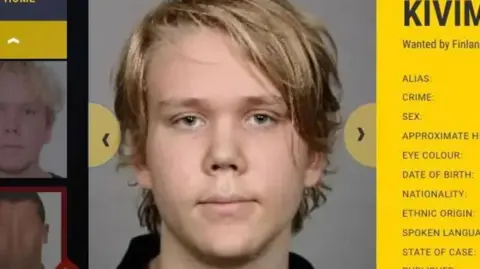
    Europol A portrait picture, akin to a mugshot, of Julius Kivimäki. He is expressionless as he looks toward the camera. He has blond hair that falls to the left of his face.Europol

    Kivimäki was sentenced to more than six years in prison for the hacking of Vastaamo

    In the months after she learned about the hack, Auer requested a hard copy of her records from Vastaamo.

    Her notes sit in a thick stack on the table between us as she tells me what happened.

    Even though their records were released more than five years ago, Vastaamo patients continue to be victimised. Someone has even built a search engine that allows users to find records on the dark web just by typing in a person’s name.

    Auer agrees to share some of her leaked therapy records with me.

    “The patient is mostly angry, impulsive, bitter,” she says, reading some of the first notes her therapist wrote about their sessions. “The patient recounts their past in a rambling manner. There is some interpersonal difficulty stemming from the patient’s weak-tempered nature, typical for their age.”

    When she read them for the first time she was heartbroken, Auer says. “I was hurt by how he had described me. It made me feel sorry for the person I had been.”

    She says the data breach has eroded patient trust. “There are a lot of people who were Vastaamo clients who had gone to therapy for years but are now never going to book another therapy session.”

    The lawyer representing Vastaamo’s victims in a civil case against the hacker has told me she knows of at least two cases where people have taken their own lives after learning their therapy notes had been stolen.

    Auer decided to confront her fears head on. She posted on social media about the hack, letting everyone know that she had been one of the victims.

    “It was a a lot easier for me to know that everyone who knew me already knew,” she says. She spoke to her family about what was in her leaked records, including the secret relationship she had never told them about before. “People were very supportive.”

    Finally, she chose to take back control of her story by publishing a book about her experiences. Loosely translated, the title is Everyone Gets to Know.

    “I crafted it into a narrative. At least I can tell my side of the story – the one that’s not visible in the patient records.”

    Auer has come to accept that her secrets will always be out there.

    “For my own wellbeing, it’s just better not to think about it.”



    Source link

  • Google appeals landmark antitrust verdict over search monopoly

    Google appeals landmark antitrust verdict over search monopoly


    Google has appealed a US district judge’s landmark antitrust ruling that found the company illegally held a monopoly in online search.

    “As we have long said, the Court’s August 2024 ruling ignored the reality that people use Google because they want to, not because they’re forced to,” Google’s vice president for regulatory affairs Lee-Anne Mulholland said.

    In its announcement on Friday, Google said the ruling by Judge Amit Mehta didn’t account for the pace of innovation and intense competition the company faces.

    The company is requesting a pause on implementing a series of fixes – viewed by some observers as too lenient – aimed at limiting its monopoly power.

    Judge Mehta acknowledged the rapid changes to the Google’s business when he issued his remedies in September, writing that the emergence of generative artificial intelligence (AI) had changed the course of the case.

    He refused to grant government lawyers their request for a Google breakup that would include a spin-off of Chrome, the world’s most popular browser.

    Instead, he pushed less rigorous remedies, including a requirement that Google share certain data with “qualified competitors” as deemed by the court.

    That data was due to include portions of its search index, Google’s massive inventory of web content that functions like a map of the internet.

    The judge also called for Google to allow certain competitors to display the tech giant’s search results as their own in a bid to give upstarts the time and resources they need to innovate.

    On Friday, Mulholland balked at being forced to share search data and syndication services with rivals as she justified the request for a halt to implementing the orders.

    “These mandates would risk Americans’ privacy and discourage competitors from building their own products — ultimately stifling the innovation that keeps the U.S. at the forefront of global technology,” Mulholland wrote.

    While the company has invested growing sums of cash into AI, those ambitions have come under scrutiny.

    Last month, the EU opened an investigation into Google over its AI summaries which appear above search results.

    The European Commission said it would probe whether Google used data from websites to provide the service and failed to offer appropriate compensation to publishers.

    Google said the investigation risked stifling innovation in a competitive market.

    This week, Google parent Alphabet became the fourth company ever to reach a market capitalisation of $4tn.


    Source link

  • Police deny Bobi Wine abduction claims as Yoweri Museveni heads for victory

    Police deny Bobi Wine abduction claims as Yoweri Museveni heads for victory


    Anita Nkonge,BBC Africaand

    Lucy Fleming

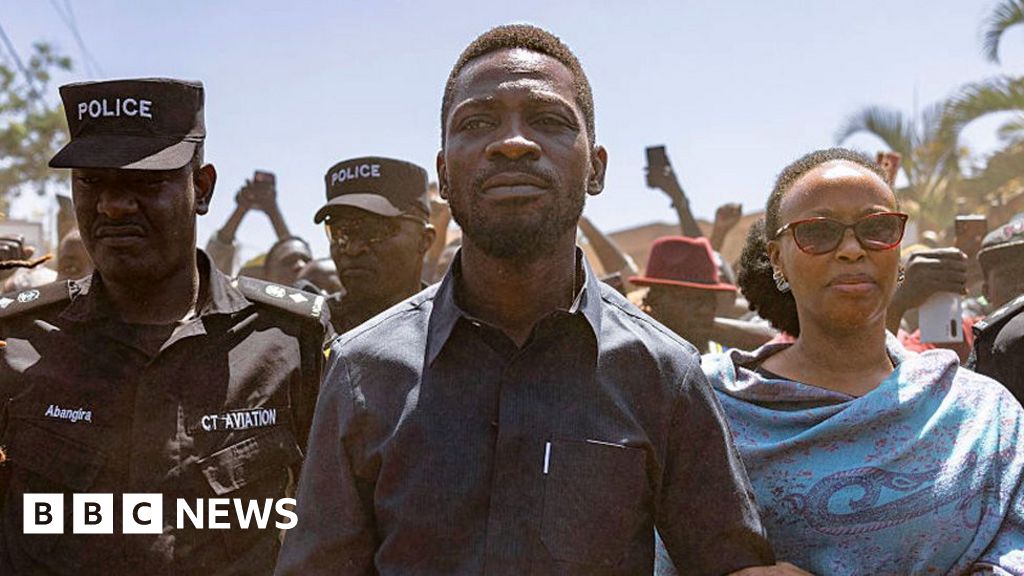
    Getty Images Bobi Wine in a black shirt flanked by a police officer and his wife in a blue shawl on voting day.Getty Images

    Bobi Wine, President Museveni’s main rival, has questioned the credibility of the results

    Police in Uganda have denied allegations that presidential candidate Bobi Wine was abducted on Friday evening as vote counting continues in the East African nation amid an internet blackout.

    Wine’s party said a helicopter landed in the grounds of his house in the capital, Kampala, and forcibly took him to an unknown location.

    Initially Wine’s son, Solomon Kampala, said both his parents had been seized, but later claimed his father “escaped” and his mother was still under house arrest, leading to confusion over the whereabouts of the opposition leader.

    The latest electoral figures from Thursday’s vote give Museveni 72% of the vote, with Wine on 24%, based on returns from 94% of polling stations.

    Speaking at a press conference on Saturday morning, police spokesman Kituuma Rusoke said the National Unity Platform (NUP) party leader was still in his home in Kampala and that it was Wine’s family members who were spreading “untrue” and “unfounded” claims.

    He said Wine’s movements were restricted because his home was an area of “security interest”.

    “We have controlled access to areas which are security hotspots,” Uganda’s Daily Monitor paper quoted him as saying.

    “We cannot allow people to use some places to gather and cause chaos. All our actions are intended to prevent anybody from creating violence or destabilising our security,” he said.

    On Friday, Wine had told his supporters to ignore the “fake results” that have been announced, saying the authorities have been “stealing the vote”. He did not provide any evidence to back up his claim and the authorities have not responded to his allegations.

    Wine’s son Solomon Kampala, who has been posting updates on social media, admitted overnight he was getting conflicting reports about the security situation at his parents’ home.

    “Amidst the raid my father was able to escape, my mother is still currently under [house] arrest, still nobody is allowed to enter the house,” he posted on X on Saturday morning.

    Difficulty accessing the internet in the country has made it hard for people to verify information.

    News that at least seven opposition supporters were killed in disputed circumstances in Butambala, about 55km (35 miles) south-west of the capital, on Thursday only emerged later on Friday.

    The US embassy then issued an alert to its citizens because of reports the security forces were “using tear gas and firing into the air to disperse gatherings”.

    During Thursday’s vote, voting was delayed by up to four hours in many polling stations around the country as ballot boxes were slow to arrive and biometric machines, used to verify voters’ identity, did not work properly.

    Some have linked the problems to the network outage.

    Electoral chief Simon Byabakama said on Friday that the vote counting had not been affected by the internet blackout and the final results would be out before 17:00 local time (14:00 GMT] on Saturday.

    Thursday’s election followed an often violent campaign, with President Museveni, 81, seeking a seventh term in office. He first took power as a rebel leader in 1986.

    Wine, a 43-year-old pop star-turned-politician, who says he represents the youth in a country where most of the population is aged under 30, has promised to tackle corruption and impose sweeping reforms, while Museveni argues he is the sole guarantor of stability and progress in Uganda.

    Although there are six other candidates, the presidential poll is a two-horse race between Museveni and Wine.

    The campaign period was marred by the disruption of opposition activities – security forces have been accused of assaulting and detaining Wine’s supporters.

    Rusoke, the police spokesperson, dismissed these complaints, accusing opposition supporters of being disruptive.

    Internet access was suspended on Tuesday, with Uganda’s Communications Commission saying the blackout was necessary to prevent misinformation, fraud and the incitement of violence – a move condemned by the UN human rights office as “deeply worrying”.

    BBC election graphics
    Getty Images/BBC A woman looking at her mobile phone and the graphic BBC News AfricaGetty Images/BBC


    Source link